
How to load rotative table for a marking process?
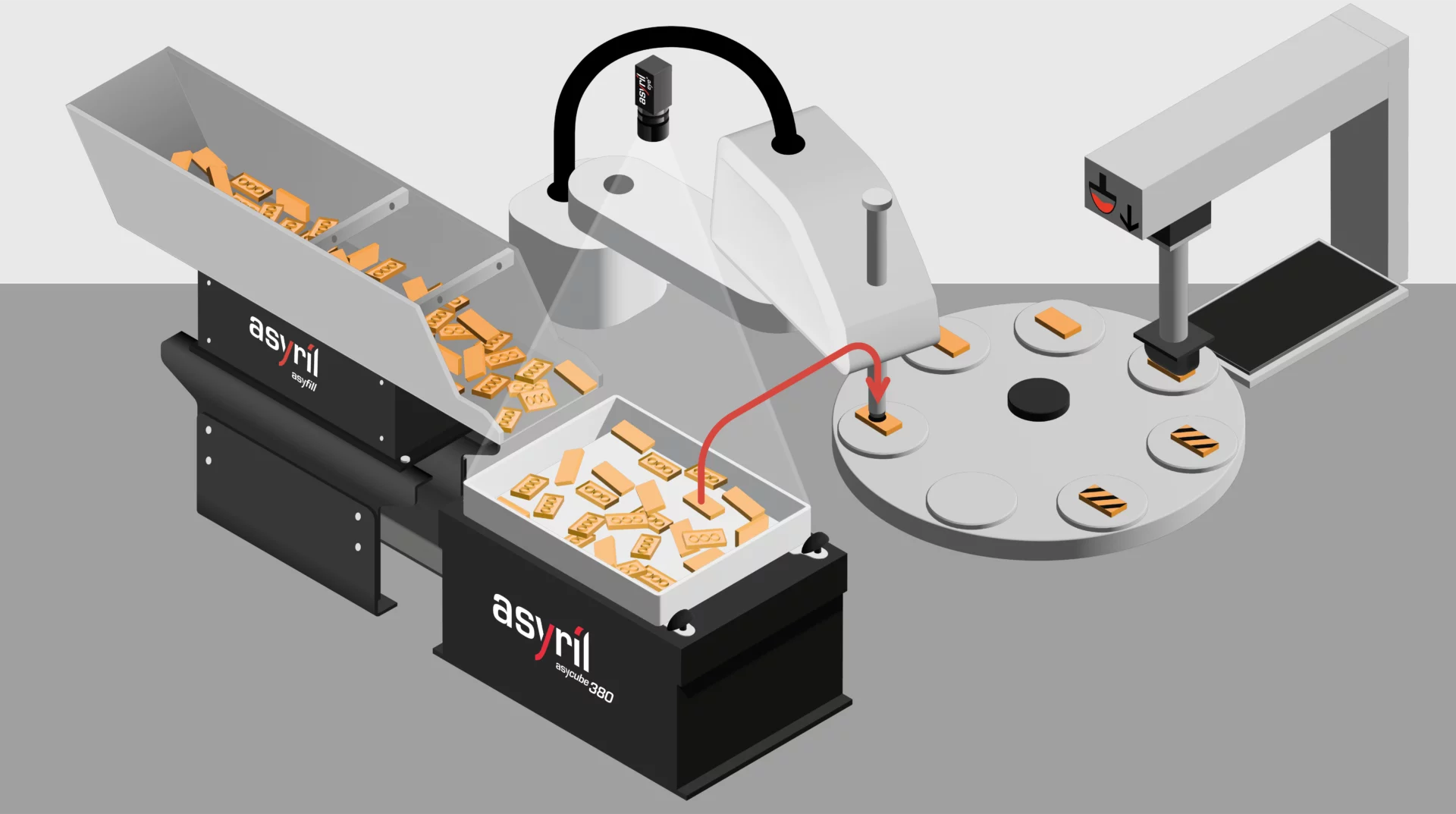
Context
Plastic-injected components such as LEGO-like parts, cosmetic caps, connectors, buttons, housings, and small technical plastic parts often require permanent or decorative marking.
Depending on the application, this can include laser marking, engraving, tamping, or pad printing used for part identification, logos, symbols or batch numbers.
These parts are produced in many shapes, colors, materials, and sizes, and often need to be marked on a specific face, angle, or reference position.
Challenge
Plastic parts can be lightweight, small, and sensitive to scratches. Before marking or pad printing, each part must be correctly oriented and positioned to ensure the marking is applied in the right location.
When parts are supplied in bulk, random orientation and geometry variations make manual loading inefficient and inconsistent. For rotary tables, the parts must be placed accurately into dedicated nests, fixtures, or cavities so that the laser or pad printing station can process them reliably.
Some parts may also require multiple orientations, inspection before marking, or controlled handling to avoid damaging visible surfaces. Repeatable positioning is essential to guarantee marking quality, readability, and aesthetic consistency.
Solution
Asyril’s flexible feeding solutions automate the orientation and loading of plastic parts into rotary tables for marking applications.
Powered by Asycube and EYE+, the solution ensures precise and repeatable part positioning while providing gentle handling of visible surfaces.
Manufacturers benefit from improved marking quality, enhanced traceability, and efficient production across a wide range of part geometries.